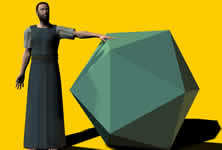
Geometry is concerned with the properties of space and the shapes and relationship of things in it. An important topic for this site. Its interesting how much of maths is related to geometry. If an algebra can be any set of objects represented by abstract symbols and a set of rules, the only criteria is that the algebra is consistent (has no contradictions) no requirement to represent reality, so why does so much of it have a geometrical interpretation?
I like to think that at its simplest level:
- Algebra - evolved from counting
- Geometry - evolved from measuring
Counting may seem more abstract and fundamental than measuring but many of its most fundamental concepts:
- Irrational Numbers
- √2 length of hypotenuse of triangle whose other sides have len=1
- π ratio of circumference to diameter of circle.
- Vectors
all seem to be studied first in geometry.
Traditional Geometry
The traditional geometry that many of us were taught at school involves two dimensional constructions with points, lines between points, angles between lines and trigonometry. This type of geometry is very useful and we use a lot of it on this site (here), examples are, proving Pythagoras theorem and the double angle formula.
Euclid was a Greek Mathematician from about 300 BC who unified what was then known about geometry and derived results from 5 postulates:
- A straight line may be drawn from any one point to any other point (any 2 points determine a unique line).
- A finite straight line may be produced to any length in a straight line.
- A circle may be described with any centre at any distance from that centre.
- All right angles are equal.
- If a straight line meets two other straight lines, so as to make the two interior angles on one side of it together less than two right angles, the other straight lines will meet if produced on that side on which the angles are less than two right angles.


 The Thirteen Books of Euclid's Elements: Book 1.
We now know about other types of geometry (known as non-Eucliden geometries) which can be derived by changing these postulates. If we change the 5th postulate, known as the parallel postulate, we get hyperbolic geometry.
Euclidean Space
Vector Space
There are disadvantages to the 'Euclids elements' approach above; we need to work out a diagram or construction for each problem and it gets a lot more complicated if we want to work in three or more dimensions.
Vectors allow us to treat geometry problems in a more analytical way, allowing us to translate to an algebraic approach. However the disadvantage with vectors is that we need to choose a coordinate system which can be quite arbitrary and the results that we are looking for can get hidden by arrays of numbers which depend on the coordinate system that we chose.
There are ways to make our results independent of the coordinate system by expressing results in terms of general basis vectors by using tensor or geometric algebra.
A vector has direction and magnitude and can therefore be used to specify the position of points relative to the origin of the coordinate system. Using vectors we can do different operations such as transforming a shape much more automatically by transforming all the vertices of the shape. we can also specify physics laws using vectors. Such operations on vectors can be specified using vector algebra, alternatively linear transforms on vectors can be specified using matrices or quaternions.
This can all be very powerful for computer graphics but there are still complications, especially if we are mixing rotations and translations, or using physics rules or swapping between coordinate systems, then there could be advantages if we can have the option of other geometry approaches available to us.
Dimensions
We are interested in two dimensional space (the main subject of traditional geometry) where we are limited to a particular plane. Here points require 2 scalar values to specify them and rotation requires one scalar value.
We are also interested in three dimensional space of course (the world that we live in and are modeling). This requires three scalar values to represent a point and three scalar values to represent a rotation.
We are also interested in higher numbers of dimensions, why? Well there are some physics theories that postulate more than 3 dimensions, which is interesting, but you may not feel this justifies a lot of your time to study it. More practically we can embed our 3D world in a higher number of dimensions to simplify the calculations, for instance, rotations in 3D are non-linear and messy to combine and work with. Embedding them in a subset of a higher dimensional space allows us to calculate the result without these problems and then translate the result back to 3D to use. For example quaternions (Note: I'm not suggesting that quaternions are vectors but they do contain 4 scalar values) we will also looks at homogeneous and conformal spaces to calculate the movement of solid objects.
Also looking at things in 'n' dimensions seems to show us an underlying structure of things, properties of 3D space that seem arbitrary when studied alone seem to fall into a pattern. Clifford Algebra is a good way of working in 'n' dimensions and group theory helps us categorise the properties. Of course, this is a more advanced option, something to study after the basics.
Elements of 'n' Dimensional Space
We will therefore investigate methods which start with very simple subsets of 'n' dimensional space (on this page);
- a point at the origin
- an infinite length line which goes through the origin
- an infinite plane which goes through the origin.
- in higher dimensions, we can extend this to hyperplanes which are like volumes in a higher number of dimensions
We can refer to these primitive linear subspaces as flats and extend them in the following ways;
- associate the flats with a scalar quantity - directed length (line associated with a scalar quantity) directed area (plane associated with a scalar quantity -area).
- offset flats - modify the primitives so they are offset from the origin.
We can then combine these shapes with intersections and unions.
The advantage of this approach is that it has the same properties for any number of dimensions. This means we can embed a three dimensional space in a higher dimensional model which allows us to deal with rotational and transnational transforms in a linear way.
Other Spaces
We are used to the idea of Euclidian Space in two or three dimensions, this is a flat space which is closest to our intuitive understanding of the world we live in. However we will find it useful to investigate other types of space, especially to simplify various transformations and interactions at the cost of embedding our model in a higher dimensional space.
| space | coordinates | metric |
|---|---|---|
| Euclidian Space | Cartesian Coordinates | ||p - q||² = (p-q)•(p-q) |
| Affine Space | ||
| Projective Space | Homogeneous Coordinates | |
| Conformal Space | ||
| Minkowski Space | ||
| Barycentric Coordinates |
Where Next?
Probably the best place to start is coordinate systems.
Other Geometry Pages
- coordinate systems
- Curves - Bezier Curves,B-Spline,NURBS (Non-Uniform Rational B-Spline)
- Shapes - Dodecahedron -Icosahedon
- transformations
- rotations (orthogonal transformations)
- rotations and translations (affine transformations)
- trigonometry
- topology
- Vector algebra
- Rotations
Concepts