For inverse kinematics (IK), the position of the end point is known, and we
need to find the angles of the joints. This is a much harder problem, there
may be many possible answers, or there may not be a set of angles that would
reach to that point. Although this is hard to do, it is useful, for example,
when posing a model it is useful to be able to drag the extremities with a mouse
and have the arms/links position themselves appropriately.
There are two approaches to solving inverse kinematics:
- Analytical - requires a lot of trigonometry or matrix algebra
- Iterative - better if there are lots of links and degrees of freedom.
IK - Analytical approach
If there are only two or three links then it may be possible to solve it analytically.
One possibly might be to draw out the arm with the angles shown on it, then
solve for the angles using geometry, a good knowledge of trig identities would
help here. The problem is that this is not really very general approach.
Another analytical approach is to represent each links rotation and translation
by a matrix. The end point is then given by all these matrixes multiplied together,
so we just need to solve this matrix equation. Then find what rotation each
matrix represents.
There may be many solutions or there may not be any solutions. In other words
there are lots of ways to reach to a given point, or it may be out of reach.
If there are many solutions, then you might need to apply additional constraints.
For instance, human joints can only bend within certain limits.
IK - Iterative approach
This is a more general approach for programming complex chains.
 |
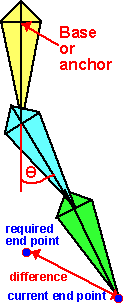
Start off with the joints in any position, then move each of the joints
in turn, so that each movement takes the endpoint toward the target.
Starting with the joint nearest the end point, rotate the joint so that
the current end point moves toward the required end point. Then do the
same with the next joint toward the base and so on until the base is rotated.
Then keep repeating this, until the end point is close enough to the required
end point or if further iterations are not moving it closer to the required
point.
It may be possible to have a more realistic strategy than this, for instance,
if I am using my arm to pick up an object then, if the object is a long
way away, I will move the bigger joints in the arm, then as the hand gets
closer the smaller joints of the hand are used for the fine adjustments.
The angle of rotation for each joint is found by taking the dot
product of the vectors from the joint to the current point and from
the joint to the desired end point. Then taking the arccos of this dot
product.
To find the sign of this angle (ie which direction to turn), take the
cross product
of these vectors and checking the sign of the Z element of the vector.
|
For more information about calculating the angle to turn see the lookAt
function here.
Data Structure
We can store the relative positions and orientations of the links in a scenegraph
as described in the forward kinematics page.
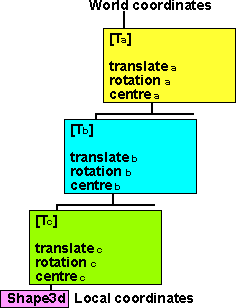
For a more detailed suggestion of how to store this information see
these pages. These pages suggest how we can specify constraints to make
different types of joints.
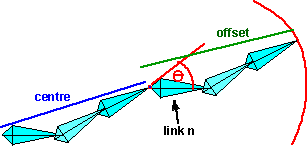
Code
So from the iterative approach above the algorithm for an n-link chain is:
sfvec3f translation[n]; // translation for each link
sfrotation rotation[n]; // rotation for each link
sfvec3f centre[n]; // centre of rotation for each link
while (distance < lastDistance) {
for (int link=0,link<n,link++) {
translation[link] = calculateOffsetForThisLink();
rotation[link] = calculateRotationForThisLink();
centre[link] = calculateCentreForThisLink();
lookAt(translation[link],rotation[link],centre[link]);
}
}
where:
- lookAt = is
defined here
- can anyone help me define these functions: calculateOffsetForThisLink(),
calculateRotationForThisLink(), calculateCentreForThisLink()

Convergence
Does this method always converge?
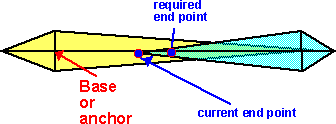
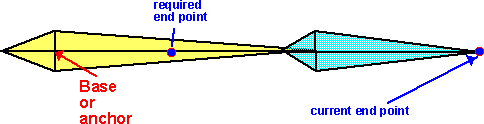
Sometimes there seem to be local minima such that changing one angle at a time
does not move us closer to the goal. For instance, the following jointed structure
which is rotated back on itself.

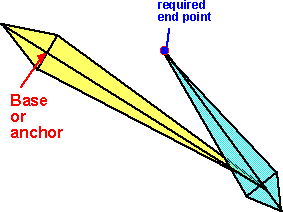
We want to get to here:

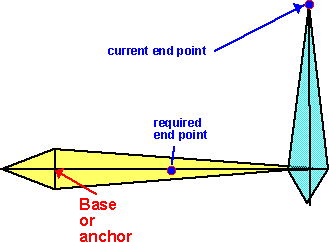
If we try an alternative starting point, but this will go to the first situation.

The following starting point will converge provided that the link attached
to the base is moved first.

I am trying to understand why this sometimes converges to the wrong point.
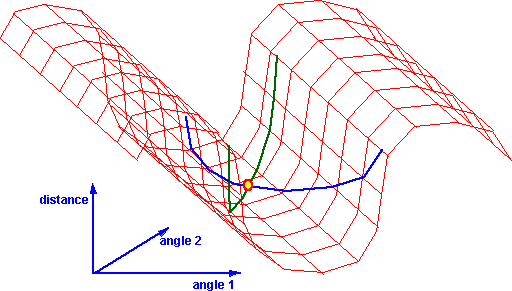
Imagine that the following graph represents the angle of the first arm (across
the screen) and the angle of the second arm (into the screen) and the height
represents the distance from the required end point, which is a function of
the two angles. Imagine that we are currently at the yellow spot. If we just
change angle 1 (blue line) then the distance will always increase as we move
from the yellow spot. Similarly if we just change angle 2 (green line) then
the distance will always increase as we move from the yellow spot. So just changing
one angle wont decrease the distance, but if we could change both angles simultaneously
then we could lower the distance.

So how can we get out of this local minima? It seems to me that we first need
a method to detect that we are not converging. If this is detected then we could
try coupling the movements (either a positive change to angle 1 happens at the
same time as a positive change to angle 2 or a positive change to angle 1 happens
at the same time as a negative change to angle 2). An alternative approach would
be that if we detect a local minima, then we randomise all the angles to see
if we can converge from a different direction.
|
metadata block
|
|
|
| see also: |
|
| Correspondence about this page |
|
|
Book Shop - Further reading.
Where I can, I have put links to Amazon for books that are relevant to
the subject, click on the appropriate country flag to get more details
of the book or to buy it from them.
|
Robot Dynamics Algorithms (Kluwer International Series in Engineering and Computer
Science, 22)
|
|
Commercial Software Shop
Where I can, I have put links to Amazon for commercial software, not
directly related to the software project, but related to the subject being
discussed, click on the appropriate country flag to get more details of
the software or to buy it from them.
|
|
SuSE Linux 11.1. Operating system with a wide range of applications
including Open Office. A good distribution for developers as it contains KDevelop.
Java, Mono, etc. Can install itself as a dual-boot system with an existing Windows OS if required.
For information about installing it see this
page. |
|
|
Can you help?
Please send me any improvements to
here. I would appreciate ideas to make the pages more useful including
error correction, ideas for new pages, improvements to wording. It helps
if you quote the full URL of the page.
|
|
|
progam
I am working on a project which uses these principles, if you would like
to help me with this you are welcome to join in, here:
|
http://sourceforge.net/projects/mjbworld/
|
This site may have errors. Don't use for critical systems.