In order to try to explain things and give some examples we can try I thought it might help to show the rotations for a finite subset of the rotation group. We will use the set of rotations of a cube onto itself, this is a permutation group which gives 24 possible rotations as explaned on this page.
Heading applied first giving 4 possible orientations:

reference orientation
angle = 0 degrees
axis = 1,0,0 |

rotate by 90 degrees about y axis
angle = 90 degrees
axis = 0,1,0 |

rotate by 180 degrees about y axis
angle = 180 degrees
axis = 0,1,0 |

rotate by 270 degrees about y axis
angle = 90 degrees
axis = 0,-1,0
or
angle = -90 degrees
axis = 0,1,0 |
Then apply attitude +90 degrees for each of the above: (note: that if we went
on to apply bank to these it would just rotate between these values, the straight
up and straight down orientations are known as singularities because they can
be fully defined without using the bank value)

angle = 90 degrees
axis = 0,0,1 |

angle = 120 degrees
axis = 0.5774,0.5774,0.5774 |

angle = 180 degrees
axis = 0.7071,0.7071,0 |

angle = 120 degrees
axis = -0.5774,-0.5774,0.5774 |
Or instead apply attitude -90 degrees (also a singularity):

angle = 90 degrees
axis = 0,0,-1
(equivalent rotation to:
angle = -90 degrees
axis = 0,0,1) |

angle = 120 degrees
axis = -0.5774,0.5774,-0.5774 |

angle = 180 degrees
axis = -0.7071,0.7071,0 |

angle = 120 degrees
axis = 0.5774,-0.5774,-0.5774 |
Normally we don't go beyond attitude + or - 90 degrees because these are singularities,
instead apply bank +90 degrees:
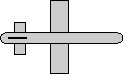
angle = 90 degrees
axis = 1,0,0
|

angle = 120 degrees
axis = 0.5774,0.5774,-0.5774 |

angle = 180 degrees
axis = 0,0.7071,-0.7071 |

angle = 120 degrees
axis = 0.5774,-0.5774,0.5774 |
Apply bank +180 degrees:

angle = 180 degrees
axis = 1,0,0 |

angle = 180 degrees
axis = 0.7071,0,-0.7071 |

angle = 180 degrees
axis = 0,0,1 |

angle = 180 degrees
axis = 0.7071,0,0.7071 |
Apply bank -90 degrees:

angle = 90 degrees
axis = -1,0,0
(equivalent rotation to:
angle = -90 degrees
axis = 1,0,0) |

angle = 120 degrees
axis = -0.5774,0.5774,0.5774 |

angle = 180 degrees
axis = 0,0.7071,0.7071
|

angle = 120 degrees
axis = -0.5774,-0.5774,-0.5774 |
encoding of these rotations in quaternions is shown here.
encoding of these rotations in matrices is
shown here.
encoding of these rotations in euler angles is
shown here.
This site may have errors. Don't use for critical systems.