Here is a really good example from Kevin Pegrume. It is an example of a collision with both linear and angular motion, but keeping the maths as simple as possible.
More table top physics - Hey, you started it :)
I hope this little gif helps visualise the tabletop goal example. The view is from above the table. The two rectangles represent two bookends or whatever to make a makeshift "goal". The pencil is initially flat on the smooth table parallel to the goal mouth. The right end marked B is "flicked" towards the right hand post. Lets say the initial velocity of B is 2 m/s. The centre marked CG appears to move at the average initial velocity of A and B. V(cg)=((2+0)/2) in this case. The rotational velocity from the point of view of appears to be (V(a) - V(b)) depending on the sign convention you are using. Notice that B comes to a stop half way there and is back up to 2 m/s by the time it hits the post. A has now come to a stop and the reaction impulse on B creates a mirror image of the start conditions and the pencil retraces it tracks. This of course only happens if A and B are parallel to the goal mouth at impact. If the posts are moved a bit closer or further away then one end may be "ahead" of the other at impact. This situation is a bit more complex but I think the calculations can be simplified by considering the "instantaneous" linear velocities of the tips at impact. Work out the resultant reaction impulse and calculate the new rotational and linear velocity from there. Now launch the pen from the same position but this time flick the right end of the pen at the right post. Depending on distance and rotational velocity one extreme end (representing one of our ideal spheres) will contact the goal post first and the pen returns exactly on the same path it launched at as concluded above. Occasionally the centre of the spinning pen enters the goal mouth before one end impacts the corner of the goalpost. The rebound of the pen seems to be approximately perpendicular to the long axis of the pen at impact. In this case it is not one of the ideal spheres that impacts but the rigid connecting rod. It is interesting to note that above a certain threshold angular velocity it is impossible to get the pen into the "back of the net" if the spinning pen clips a goal post. If the angular velocity to rebound angle relationship can be determined (and it does not appear to be too complicated) I am sure this would be a useful formula for approximating collisions calculations in general. |
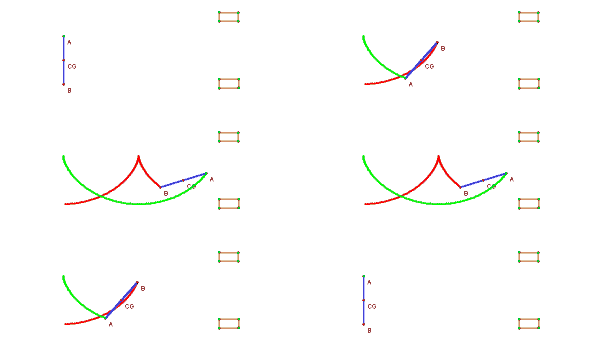
Assume:
velocity of CG = 1 m/s
distance between A and B = 1 m (big pen, I know, but it makes the maths easier)
distance between start point and goal = 2 m
time to travel to goal = 2 s
rotation speed = 1 rotation per 2 seconds = 2*PI/2 radians per second = PI radians per second
Calculation of impulse at collision:
First case
assume total mass of 1 Kg concentrated at A and B (i.e. 0.5 Kg at A and 0.5 Kg at B connected by rigid, massless link).
Calculate impulse in two ways, using a numerical method (sum of effect of each mass) and analytically (add impulse caused by linear and angular movement).
Taking Each Mass Seperately
At collision change of momentum of point A = 0.
At collision change of momentum of point B = from 2 m/s to -2 m/s = 4 m/s * 0.5 Kg = 2 Kg m/s
So total change of momentum = 2 Kg m/s
In terms of Linear And Rotational Momentum
Linear momentum:
change in liner momentum = change of momentum of CG (1 Kg from 1m/s to -1 m/s) = 2 Kg m/s
Angular momentum:
angular momentum before = mass * radius^2 * angular velocity
= (2*0.5)Kg * (0.5)^2 m²* PI /s
= 0.25* PI Kg m² /s
so change in angular momentum = 0.5* PI Kg m² /s
The impulse required to change this angular momentum is
Second case
assume total mass of 1 Kg distributed evenly between A and B (i.e. 1 Kg per metre).
Calculate impulse in two ways, using a numerical method (sum of effect of each mass) and analytically (add impulse caused by linear and angular movement).
Taking Each Mass Seperately
At collision change of momentum = ∫(2*x) dx
where x = distance along pen from point A
So total change of momentum = 2 Kg m/s
Analytical method
I'll leave this for you to do.


