Prerequisites
If you are not familiar with this subject you may like to look at the following
pages first:
Description
Again dual numbers are similar to the form for complex numbers above except that:
w2 = 0
Algebras which have this property are known as grassmann Algebras, in Clifford Algebra terms, this is the outer or exterior product. Vector cross products also have the same property.
It may seem strange that the square root of a non-zero quantity is zero, although it makes some kind of sense, because the square of a very small quantity is a very, very small quantity. However this is a multidimensional value where multiplying various components may produce different components, for example in Clifford Algebra multiplying one vector by another produces a scalar (So the vector component of this product will be zero). Another example is the vector cross product which produces zero when a vector is multiplied with itself.
In this case we will denote w with the symbol 'ε'
As with the other algebras here, addition is defined by adding corresponding terms and the flavor of the algebra comes from the multiplication rules. If we denote the two dimensions by 1 and e then a '1' term is given by multiplying the same types together, a 'ε' term is given by multiplying different terms. There are no sign changes. So we can define the algebra by the following table:
| a*b |
b.1 |
b.ε |
| a.1 |
1 |
ε |
| a.ε |
ε |
0 |
Inverse of dual multiplication
dividing a by b gives:
| a.1 + ε a.ε |
(a.1 + ε a.ε) |
(b.1 - ε b.ε) |
a.1 * b.1 |
(a.ε * b.1) - (a.1 * b.ε) |
| -------------- = |
--------------- * |
-------------- = |
------------ + |
ε ---------------------------- |
| b.1 + ε b.ε |
(b.1 + ε b.ε) |
(b.1 - ε b.ε) |
b.12 |
b.12 |
so if b.ε = 0 then we don't need to use this method and we just divide by scalar.
otherwise the real part is: (a.1 * b.1)/b.12
and the dual part is: (a.ε * b.1 - a.1 * b.ε)/b.12
so the inverse is:
(b.1 - ε b.ε)/b.12
Modeling with Pauli Matrix
The number a + b ε
can be represented by:
Applications
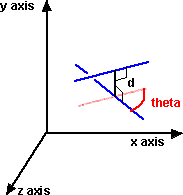
Dual numbers can represent the relationship of two lines in 3 dimensions. This is explained further here.
The relationship between the lines is represented by the dual number:
theta + d ε
where:
- theta is the angle between the lines (in radians)
- d is the distance between the lines
- ε is the dual operator
if theta=0 then the lines are parallel
if d=0 then the lines intersect
Further Reading
|
metadata block |
|
|
| see also: |
|
| Correspondence about this page |
|
|
Book Shop - Further reading.
Where I can, I have put links to Amazon for books that are relevant to
the subject, click on the appropriate country flag to get more details
of the book or to buy it from them. |
Quaternions and Rotation Sequences.
|
|
Commercial Software Shop
Where I can, I have put links to Amazon for commercial software, not
directly related to the software project, but related to the subject being
discussed, click on the appropriate country flag to get more details of
the software or to buy it from them. |
SuSE Linux 11.0. Operating system with a wide range of applications
including Open Office. A good distribution for developers as it contains KDevelop.
Java, Mono, etc. Can install itself as a dual-boot system with an existing Windows OS if required.
For information about installing it see this
page.
|
Can you help?
Please send me any improvements to here. I would appreciate ideas to make the pages more useful including
error correction, ideas for new pages, improvements to wording. It helps
if you quote the full URL of the page. |
|
|
Terminology and Notation
Specific to this page here:
|
|
|
program
I am working on a project which uses these principles, if you would like
to help me with this you are welcome to join in, here: |
http://sourceforge.net/projects/mjbworld/ |
This site may have errors. Don't use for critical systems.