The aim of this page is to propose an XML encoding for source code. This is
to enable simpler translation between different language source code, code generators
and XMI.
Variables, declaration and assign.
Variables may be defined, initialised and used in the same statement or in
seperate statements. Any variables may also be used in arrays.
All of these things are based on variable node, even assignment will allways
have a varible on the left hand side.
When a variable is used we need a quick way to link it back to its definition,
how do we define such a link? we need to do this both for local variables, class
varibles and varibles in other classes, how do we implement late binding of
variables?
Should all node names be expanded out to their full path name?
| Java example |
|
XES |
int var1;
|
 |
<variable name="var1"/>
|
var1 = 1;
|
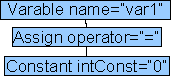 |
<variable name="var1">
  <assign operator="=">
    <constant intConst="1"/>
  </assign>
</variable>
|
int var2 =2;
|
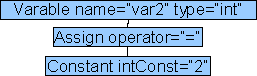 |
<variable name="var2.2"/>
|
int[] array1;
|
 |
<variable name="array1" type="int" array="true"/>
|
array1 = new int[1];
|
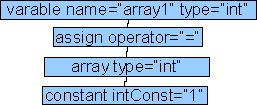 |
<variable name="array1">
  <assign operator="=">
    <array>
      <constant intConst="1"/>
    </array>
  </assign>
</variable>
|
array1[0]=3;
|
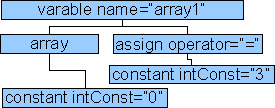 |
<variable name="array1">
  <array>
    <constant intConst="0"/>
  </array>
  <assign operator="=">
    <constant intConst="3"/>
  </assign>
</variable>
|
int[] array2=new int[2];
|
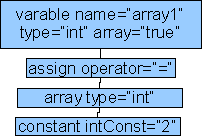 |
<variable name="array2" type="int" array="true">
  <array>
    <constant intConst="2"/>
  </array>
</variable>
|
| double x,y,z; |
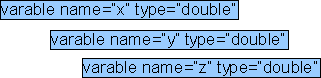 |
is:
<variable name="x.y.z"/>
should be:
<declare type=double>x</declare>
         <declare type=double>y</declare>
         <declare type=double>z</declare>
|
|
JDK
1.5 allows Generic Types:
ArrayList<Integer> list = new ArrayList<Integer>();
JDK
1.5 also allows enum:
public enum StopLight { red, amber, green };
|
|
<assign name="list" declare="ArrayList" generic="Integer">
  ArrayList
</assign>
<declare type=enum values="red, amber, green">
  StopLight
</declare>
|
| String values[] = (String []) names; |
|
<assign name="values" declare="String" array=true>(String
[]) names</assign>
other possible parameters:
type = "=" default
type = "++pre"
type = "++post"
type = "--pre"
type = "--post"
type = "+="
type = "-="
type = "*="
type = "/="
type = "%="
type = "&="
type = "|="
type = "^="
type = "<<="
type = ">>="
type = "<<<="
|
| |
|
|
| |
|
|
Comment
| Java example |
XES |
/* text */
// one line comment |
<comment>text</comment>
(each line held in separate<comment> tags
|
Class Declaration
| Java example |
XES |
/** class meta description */
class date extends Object {
...
} |
<classdec name="date" extends="Object" meta="text
description"> ...parameters ... methods ...</classdec>
other parameters:
abstract=true
|
|
JDK
1.5 allows metadata following @ sign
@meta class date extends Object {
...
}
|
|
Class Call
this needs more work as class call could occur anywhere in the right hand side
of equation
| Java example |
XES |
| date d = new date(day,month,year); |
<class name="date"> <param/ name="day">
<param/ name="month"> <param/ name="year"></class> |
Method Declaration
| Java example |
XES |
|
/** move to a point on screen
* @param x how far from left of screen
* @param y how far from bottom of screen
* @returns successful did it work*/
public boolean move(int x,int y){
body
}
|
<methoddec name="move" tag="move to a point on screen">
<param name="x" type="int" tag="how far from
left of screen">
<param name="y" type="int" tag="how far from
bottom of screen">
...body ...
</methoddec>
other parameters:
public=true
protected=true
private=true
final=true
synchronised=true
native=true
|
|
Support for javadoc
style tags
possible tags are:
@author classes and interfaces only
@version classes and interfaces only
@param methods and constructors only)
@return methods only)
@exception (@throws is a synonym added in Javadoc 1.2)
@see
@since
@serial (or @serialField or @serialData)
@deprecated
|
|
|
JDK
1.5 allows metadata following @ sign
@meta public boolean move(int x,int y){
body
}
|
<methoddec name="move" metadata="meta">
|
Method Call
This is part of assignment (or can be) but I think it is important that method
calls are structured so that it is easier to process the structured data to
convert to other languages and to make sure that calls link to declarations.
So we need to do more work on the structuring of right hand side of equations.
| Java example |
XES |
| result = move(10,20); |
<assign result="values">
<call name="move"><param="10"><param="20">
</call>
</assign>
|
Package Declare
| Java example |
XES |
| package myprogram; |
<package name="myprogram"/> |
Package Import
| Java example |
XES |
| import java.io.DataInputStream; |
<import package="java.io" classname="DataInputStream"/> |
Interface Declare
| Java example |
XES |
|
/** class meta description */
interface pressEvent {
...
}
|
<interfacedec name="pressEvent" > ... methods ...</classdec>
other parameters:
abstact=true
extends="name"
public=true
|
Conditionals
| Java example |
XES |
|
if (a==0)
else
switch (a) {
case 0 : ...
case 1 : ...
default: ...
}
|
<if> <test>a==0</test>... <else/> ... </if>
<switch variable="a">
<case value=0> ... </case>
<case value=1> ... </case>
<default> ... </default>
</switch>
|
Loops
XES has only one loop type, the java loop types (for, while, do) map to loop
by using different combinations of:
- initialise
- operation
- pre-condition
- post-condition
loop has a attribute 'code' which can be (for, while, do) which specifies which
combination of (initialise, operation, pre-condition, post-condition) elements
are expected between this node. This seems a bit restictave and specific, can
anyone think of a better way to specify which subnodes are initialise, operation,
pre-condition or post-condition?
| Java example |
|
XES |
for (int i=0;i<3;i++) {
  break;
}
|
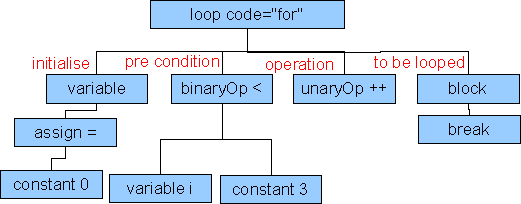 |
<loop code="for">
<variable name="i.0"/>
<binaryOp operator="<">
<variable name="i"/>
<constant intConst="3"/>
</binaryOp>
<call name="i"/>
<block>
<break/>
</block>
</loop>
|
while (true) {
  break;
}
|
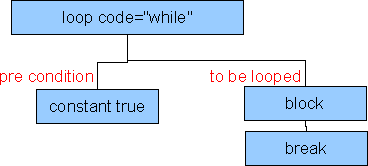 |
<loop code="while">
  <constant boolConst="true"/>
  <block>
    <break/>
  </block>
</loop>
|
do {
  break;
} while (true);
|
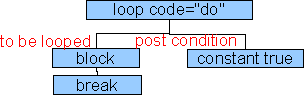 |
<loop code="do">
  <block>
    <break/>
  </block>
  <constant boolConst="true"/>
</loop>
|
|
JDK
1.5 allows enhanced for loop:
for (Integer i : list)
|
|
|
Exceptions
| Java example |
XES |
|
try {
} catch () {
}
|
<try>
<catch>
</try>
|
This site may have errors. Don't use for critical systems.